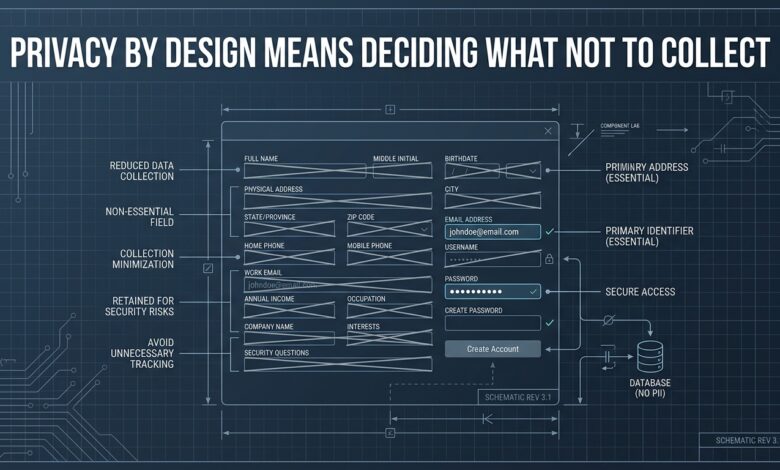
Key takeaway: The cheapest privacy control is the field that was never added to the form. Every subsequent control — access restriction, retention limits, deletion handling — exists to manage data that a design decision could have avoided collecting in the first place.
Why Retrofitting Is So Much Harder
A product ships collecting broad data because it seemed potentially useful, or because a form template included fields nobody specifically needed, or because “we might want this analysis later” felt like sufficient justification at the time.
Two years later, that data exists in the primary database, replicated to a warehouse, exported to three analytics tools, and referenced by a dashboard someone built without documenting the dependency. Removing it now requires finding every consumer, negotiating with whoever built the dashboard, and accepting the risk of breaking something nobody remembers depending on it. Not collecting it in the first place would have cost nothing.
The Questions That Belong at Design Time
Before adding any field or event to a data model, three questions determine whether privacy-by-design is actually being practised rather than merely referenced in a policy document.
| Question | What it prevents |
|---|---|
| What specific decision does this data enable? | Collection with no defined use |
| Could a less identifying version serve the same purpose? | Unnecessary precision |
| What is the plan for deleting it? | Indefinite retention by default |
The second question catches a specific and common failure: collecting an exact birthdate when an age band would answer every actual business question, or a precise location when a city-level value suffices. The more identifying version is usually collected because it required no additional thought, not because the product genuinely needed that precision.
Designing the Defaults
Systems accumulate expansive data collection because the default is to collect broadly and narrow later if someone objects, rather than the reverse. Reversing that default — collect narrowly, expand only when a specific justified need arises — produces a materially smaller and more defensible dataset over the system’s life, at the cost of occasionally needing to add a field later when a genuine need appears.
Consent and disclosure should match what is actually collected, specifically. A broad, vague consent statement covering everything the system might ever collect provides weak legal grounding and poor user understanding compared to a specific statement matching an intentionally narrow collection design.
Retention as a Design Decision, Not an Afterthought
Attach a retention period to data at the point of collection rather than treating retention as a cleanup project scheduled for whenever someone gets to it. A field added with an explicit ninety-day retention policy is fundamentally different from one added with no retention plan at all, because the former is enforced automatically and the latter accumulates indefinitely by default.
This decision is cheapest exactly when the field is created, since a data model designed with retention in mind from the start can implement automatic expiry directly. Retrofitting retention onto years of accumulated, undifferentiated data is a substantial and often incomplete project.
Making This Practical for Product Teams
Privacy-by-design fails when it exists only as a review gate near launch, arriving too late to influence the data model that was already built. It succeeds when the three design-time questions are part of the same process as any other design decision — alongside performance, usability and cost — asked while the data model is still a proposal rather than after it is already in production and difficult to change.
The Bottom Line
Ask what decision each piece of collected data actually enables, whether a less identifying version would serve equally well, and what the deletion plan is — at design time, not as a retrofit. Default to narrow collection with deliberate expansion rather than broad collection with occasional pruning, because the asymmetry in cost between the two approaches only grows over the system’s life.