Recording Privileged Sessions Changes Behaviour Before Anyone Reviews the Tape

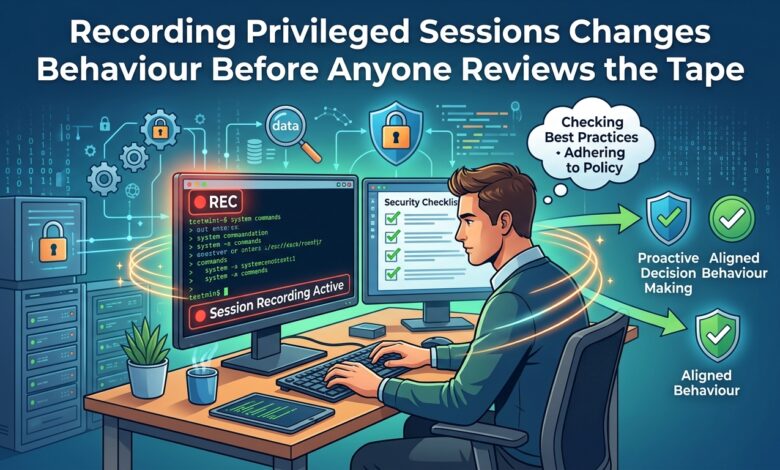
Key takeaway: Session recording for privileged access serves two distinct purposes — deterrence through awareness, and forensic reconstruction after the fact — and only one of them requires anyone to actually review the recordings routinely.
Two Different Jobs, One Mechanism
Recording what a privileged user does during an administrative session — every command, every screen, every file accessed — is usually justified as an investigative tool. That framing undersells its more common value.
The deterrent effect operates continuously and requires no review at all. An administrator who knows their session is recorded behaves differently than one who believes their actions are unobserved, in the same way that visible security cameras change behaviour regardless of whether anyone is watching the monitor in real time. This is the value delivered on every ordinary day when nothing goes wrong.
The forensic value activates only during an investigation, and it is what makes the difference between reconstructing exactly what happened during an incident and relying on incomplete logs and someone’s memory of events.
What to Actually Record
| Session type | Recording depth | Justification |
|---|---|---|
| Standing administrative access | Full session, keystrokes and screen | Highest risk, least visibility otherwise |
| Just-in-time elevated access | Full session for the elevation window | Time-bounded, so recording is proportional |
| Third-party vendor remote access | Full session, mandatory | External party, no other visibility |
| Regular user sessions | Not typically recorded | Disproportionate for the risk level |
| Break-glass emergency access | Full session, alert on use | Rare, high-stakes by definition |
Third-party vendor access deserves particular attention because it is often the least visible category otherwise. A vendor with remote access to perform maintenance is, from a risk perspective, an external party with privileged access and no other monitoring — recording their session is frequently the only visibility an organisation has into what a third party actually did during a maintenance window.
Making Review Feasible
Recording everything and reviewing nothing has real value through deterrence and still misses actionable findings until an incident forces someone to search the recordings retroactively. The gap is closed by making review selective rather than comprehensive.
Flag sessions for review based on risk signals rather than reviewing every recording: access to an unusually sensitive system, a session outside normal working hours, commands matching known dangerous patterns, or access following a recent permission change. This converts an unmanageable volume of footage into a small, prioritised queue that a security team can actually review.
Automated command-pattern detection within recordings — flagging specific dangerous commands like mass deletion, permission changes, or data export — turns passive recording into active detection without requiring a human to watch every session.
The Privacy and Trust Question
Recording privileged sessions is a legitimate control and a genuine trust question for the administrators being recorded. Communicate the policy clearly rather than deploying it silently — administrators discovering covert recording after the fact damages trust more than transparent recording ever would, and transparent recording still delivers the deterrent effect since deterrence depends on the subject knowing recording exists.
Scope recording to privileged and administrative activity specifically, not general employee monitoring, and be explicit about that scope in the policy so it is understood as a control on elevated risk rather than general surveillance.
The Bottom Line
Record full privileged, just-in-time and third-party vendor sessions, and treat the deterrent value as real even without routine review. Make actual review selective and risk-based rather than attempting to watch everything, and communicate the policy transparently so the deterrent effect is preserved and trust is not damaged by covert monitoring.