Shifting Left Failed Because You Shifted the Alerts, Not the Work

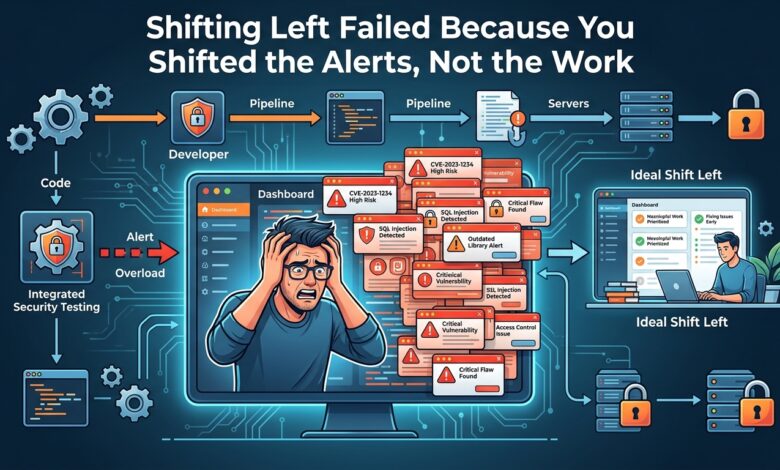
Table of Contents
- The Alert Volume Problem
- Why Static Analysis Disappoints
- Signal Over Coverage
- Where Security Belongs in the Lifecycle
- Lightweight Threat Modelling
- Secure Defaults Beat Secure Code
- Security Champions and Their Failure Modes
- Metrics That Reflect Reality
- Common Pitfalls
- Conclusion
- Frequently Asked Questions
Key takeaway: Shifting left works when developers receive few, accurate, actionable findings inside their existing workflow. Shifting a scanner earlier without reducing false positives moves the noise rather than the security.
The Alert Volume Problem
A team adopts static analysis in the pipeline. The first run produces four thousand findings.
Nobody triages four thousand findings. The build is configured to warn rather than fail, because failing on four thousand findings blocks all delivery. Warnings that do not block get ignored. Six months later the count is six thousand and the tool is functionally decorative.
This is the standard outcome, and it is not a discipline failure. It is a predictable response to a volume nobody could process.
The underlying error is treating coverage as the goal. A tool reporting every theoretically possible issue appears thorough and produces an output that cannot be acted upon. Meanwhile the genuinely exploitable authorisation flaw sits at position 2,847 in a list nobody reads.
What developers need is the opposite: a small number of findings that are almost certainly real, presented where they are already working, with enough context to fix them. Ten accurate findings acted upon reduce risk more than four thousand ignored.
Why Static Analysis Disappoints
Understanding the tooling’s limits prevents unrealistic expectations and explains the false positive rate.
Data flow analysis is approximate. Determining whether attacker-controlled input reaches a dangerous operation requires tracing through function calls, framework magic, dependency injection, and dynamic dispatch. Analysers approximate, and approximation in the safe direction means reporting paths that cannot actually occur.
Framework behaviour is invisible. A framework that escapes output automatically, or validates input via a decorator, is frequently not understood by the analyser. It reports the vulnerability the framework already prevents.
Business context is unavailable. Whether a field is sensitive, whether an endpoint is internal, whether a value is attacker-controlled — none of this is in the code. The analyser cannot distinguish a genuine authorisation gap from an intentionally public endpoint.
Compensating controls are unknown. A finding may be mitigated at the gateway, by network isolation, or by an upstream validation layer the analyser never sees.
What static analysis does reliably: pattern-matching for specific dangerous constructs — hardcoded secrets, known-bad cryptographic primitives, string-concatenated queries, disabled certificate validation. These are high-confidence, low-false-positive, and worth blocking on.
What it does unreliably: complex data flow reasoning and anything requiring business context.
The practical conclusion is to configure aggressively for the first category and treat the second as advisory rather than blocking. Most default configurations do the opposite.
Signal Over Coverage
Concretely, how to reduce a four thousand finding baseline into something useful.
Suppress the baseline, gate the delta. Existing findings become a tracked backlog. The pipeline blocks only new findings introduced by the change under review. This makes the gate immediately achievable and prevents accumulation, which is the property that matters.
Enable only high-confidence rules initially. Hardcoded credentials, weak cryptography, injection through string construction, disabled TLS verification. Expand once these are consistently clean.
Filter by reachability where the tool supports it. A vulnerability in code no entry point reaches is not equivalent to one in a request handler.
Deduplicate aggressively. The same pattern in forty files is one finding with forty locations, not forty findings.
Route findings to the diff, not to a dashboard. A comment on the specific line in the pull request is acted upon. A dashboard entry is not.
Measure and prune by false positive rate. Any rule producing mostly false positives should be disabled. Retaining it trains developers to dismiss all findings, which costs more than the rule provides.
That last practice is the one most teams resist, because disabling a rule feels like reducing security. The opposite is true — a rule that produces noise reduces the credibility of every other rule.
Where Security Belongs in the Lifecycle
Different activities fit different stages, and matching them correctly is most of what “shift left” should mean.
Design. Threat modelling on significant changes. This is the highest-value security activity available, because design flaws cannot be found by any scanner and are the most expensive to fix later.
Development. Secure defaults in frameworks and libraries, editor-integrated feedback for high-confidence issues, and secret scanning at commit time.
Pull request. Findings on the diff, dependency checks on new dependencies, and human review focused on authorisation and failure modes rather than style.
Build. Dependency vulnerability scanning, secret scanning of artefacts, container configuration policy, and artefact signing.
Pre-deployment. Dynamic testing against a running instance, infrastructure configuration policy, and admission control.
Production. Runtime monitoring, anomaly detection, and a vulnerability disclosure path for external reports.
The item worth emphasising is the first. Threat modelling at design time catches the class of problem tooling structurally cannot — missing authorisation boundaries, trust assumptions between components, data flowing somewhere it should not. Teams that skip design-stage security and invest heavily in scanning are addressing the cheaper category of defect while the expensive one goes unexamined.
Lightweight Threat Modelling
Formal threat modelling methodologies are thorough and rarely adopted, because they require specialist facilitation and hours per session. A lightweight version gets performed, which makes it more valuable.
Four questions, thirty minutes, on any change that touches trust boundaries, handles new data types, or adds an external integration:
What are we building? A rough diagram — components, data stores, and the flows between them. Drawn on a whiteboard, not produced in a modelling tool.
What can go wrong? Where does untrusted input enter, what happens if each component is compromised, what data crosses a boundary, and what authorisation decision is made where.
What are we doing about it? Specific mitigations for the specific concerns raised, written down as work items rather than intentions.
Did we do a good enough job? A brief review after implementation confirming the mitigations exist.
Two practices make this stick. Have engineers run it themselves rather than requiring a security specialist, with security available for consultation — specialist-dependent processes do not scale and become a bottleneck that teams route around. And record the output somewhere durable, because the value compounds across changes to the same system and evaporates if it lives on a whiteboard photograph.
The consistent experience of teams that adopt this is that the exercise surfaces missing authorisation checks and unexamined trust assumptions in nearly every session, and that these are precisely the findings no scanner produces.
Secure Defaults Beat Secure Code
The highest-leverage security work is making the easy path the safe path, because it removes the need for every developer to know every pitfall.
Framework-level output encoding. Templating that escapes by default means cross-site scripting requires deliberately bypassing it.
Query builders and parameterised interfaces. If string-concatenated queries are not the convenient option, injection largely disappears.
Authentication and authorisation as framework middleware. A default-deny pattern where endpoints must explicitly declare their access requirement converts a forgotten check from a silent vulnerability into a startup error.
Secret management as the only available mechanism. If configuration loads from a secret manager and there is no path for a literal credential, secrets stop appearing in code.
Hardened base images and templates. New services inherit non-root execution, read-only filesystems, and minimal capabilities without anyone configuring them.
Vetted libraries for cryptography and validation. One correct implementation rather than each team choosing.
The pattern is that each of these eliminates a vulnerability class rather than detecting instances of it. A team of thirty developers cannot reliably remember thirty pitfalls on every change. A framework where the pitfall is not reachable does not require them to.
This is also why platform teams have more security leverage than security teams in most organisations. Whoever controls the templates and the framework controls the default security properties of everything built on them.
Security Champions and Their Failure Modes
The champions model — an engineer in each team with additional security responsibility — is widely recommended and frequently implemented badly.
Where it works: the champion has genuine allocated time, real training rather than an afternoon presentation, a direct line to the security team, and their contribution is recognised in performance review.
Where it fails: the role is assigned without time allocation, so it is unpaid additional work. Training is superficial, so the champion cannot answer the questions they receive. The role becomes a queue — the champion performs all security work for the team rather than raising the team’s capability. And there is no recognition, so it becomes something to avoid.
The distinguishing question is whether the champion is a multiplier or a bottleneck. A champion who runs threat modelling sessions and teaches their team is a multiplier. A champion who receives all security questions and answers them is a bottleneck who has reduced the rest of the team’s engagement.
Metrics That Reflect Reality
Most security programme metrics measure activity rather than outcome.
Weak metrics: number of findings, number of scans, training completion percentage, tool coverage. All measurable and none indicate whether the software is more secure.
Useful metrics: time from vulnerability introduction to detection, time from detection to remediation for genuine issues, percentage of new findings versus accumulated backlog, escape rate of issues found in production that earlier stages should have caught, false positive rate per rule, and threat model coverage of significant changes.
| Metric | What it reveals |
|---|---|
| Escape rate to production | Whether earlier stages are effective |
| Mean time to remediate critical | Whether findings lead to action |
| False positive rate per rule | Whether tooling is credible |
| New vs backlog findings | Whether the situation improves or accumulates |
| Threat models per significant change | Whether design-stage security happens |
Escape rate is the closest available proxy for programme effectiveness. If issues that static analysis or review should have caught are being found in production, the earlier stages are not working regardless of how many findings they produce.
Common Pitfalls
Enabling every rule immediately. Produces unactionable volume and destroys tool credibility.
No baseline suppression. Blocking on a large existing backlog makes the gate impossible to satisfy.
Findings in a separate dashboard. Developers act on what appears in their workflow.
Retaining noisy rules. Trains dismissal of all findings, including accurate ones.
Scanning without design-stage security. Tooling cannot find missing authorisation boundaries.
Champions without allocated time. Unpaid additional work is not a programme.
Measuring activity rather than outcome. Finding counts say nothing about whether software improved.
Conclusion
Shifting left succeeded as a slogan and frequently failed in practice, because moving a scanner earlier without reducing its output moves the noise rather than the security.
What works is a small number of high-confidence checks, gating only new findings, delivered as comments on the diff where developers are already working. Noisy rules disabled rather than tolerated. That configuration produces findings people act on, which is the only kind that reduces risk.
Around the tooling, the higher-value work is lightweight threat modelling on significant changes — thirty minutes, four questions, run by engineers rather than specialists — because design flaws are what scanners structurally cannot find. And secure defaults in frameworks and templates, because eliminating a vulnerability class beats detecting its instances, and it does not require every developer to remember every pitfall.
Then measure escape rate rather than finding count. Whether issues reach production that earlier stages should have caught is the question that indicates whether any of it is working.
Frequently Asked Questions
Should pipelines fail on security findings? On high-confidence categories, yes — hardcoded secrets, weak cryptography, injection through string construction. On complex data flow findings with meaningful false positive rates, advisory is more appropriate.
How is a large existing backlog handled? Suppress it as a tracked baseline and gate only new findings. Then work the backlog by exploitability rather than by tool severity, which correlates poorly with actual risk.
Is dynamic testing worth adding alongside static analysis? Yes, because it finds different issues — configuration problems, authentication flaws, and runtime behaviour that static analysis cannot observe. It requires a running environment and produces fewer false positives.
Who should perform threat modelling? The engineers building the thing, with security available for consultation. Specialist-led modelling does not scale and becomes a bottleneck teams learn to bypass.
How much developer time should security consume? If tooling is well-configured, very little routinely — a few minutes per pull request. Threat modelling adds half an hour per significant change. Programmes consuming substantially more are usually generating noise.
Are bug bounty programmes worthwhile? Once internal processes are functioning. Launching one while basic issues remain unaddressed produces a flood of findings and cost. It is a complement to a working programme rather than a substitute.
What is the single highest-value change? Secure defaults in the framework and service templates. It eliminates vulnerability classes for every service built afterwards without requiring anyone to remember anything.